11 Active Listening Skills To Practice
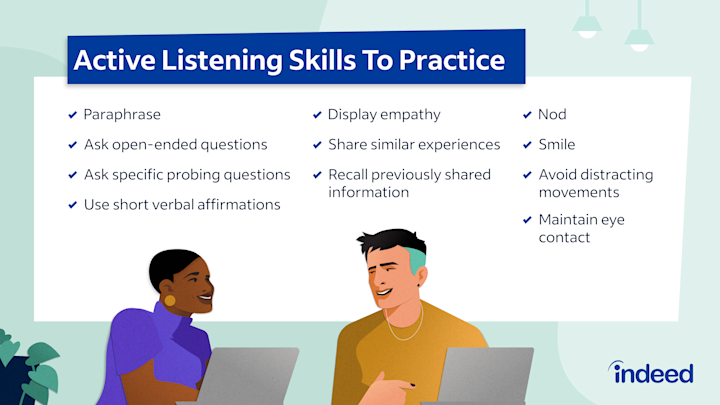
One of the most critical skills in effective communication is active listening. Developing this soft skill will help you build and maintain relationships,solve problems, improve processes and retain information, such as instructions, procedures and expectations.
In this article, we discuss active listening skill, why they’re important and how you can improve your active listening skills.
What is active listening?
Active listening is the ability to focus completely on a speaker, understand their message, comprehend the information and respond thoughtfully. Unlike passive listening, which is the act of hearing a speaker without retaining their message, this highly valued interpersonal comunication skill ensures you’re able to engage and later recall specific details without needing information repeated.
Active listeners use verbal and non-verbal techniques to show and keep their attention on the speaker. This not only supports your ability to focus, but also helps ensure the speaker can see that you are focused and engaged. Instead of thinking about and mentally rehearsing what you might say when the speaker is done, an active listener carefully considers the speaker’s words and commits the information to memory.
Why is active listening important in the workplace?
Whether you’re seeking a new job opportunity, striving to earn a promotion or working to improve in your current role, improving your active listening skills will help you succeed. Much like critical thinking and conflict resolution, this soft skill will help increase your value as an employee.
Being an active listener can help you accomplish the following:
Build connections
Active listening helps others feel comfortable sharing information with you. When you demonstrate your ability to sincerely listen to what others have to say, people will be more interested in communicating with you on a regular basis. This can help open up opportunities to collaborate with others, get work done quickly or start new projects. All of these things can help lead you to success in your career.
Develop trust
When people know they can speak freely to you without interruptions, judgment or unwelcome interjections, they’ll be more likely to confide in you. This is especially helpful when meeting a new customer or business contact with whom you want to develop a long-term working relationship.
Identify and solve problem
Actively listening to others will help you detect challenges and difficulties others are facing, or problems within projects. The more quickly you’re able to spot these issues, the sooner you can find a solution or create a plan to address them.
Increase your understanding of various topics
Great employees are always striving to learn something new and grow their knowledge base. Because active listening helps you retain information, it will also help you better understand new topics and remember what you’ve learned so you can apply it in the future.
Avoid missing critical information
Because active listeners are highly engaged with the speaker, they’re able to recall specific details. This is especially important when the speaker is proving instructions, training you on a new process or delivering a message you’re responsible for passing along to others.
Good work. I enjoy reading this
ReplyDeleteIt is a great post!
ReplyDeleteI agree with your points. thanks for the information
ReplyDelete